
|
Christoph's Tape Pages - Comparison Test ASC 6002 ST / Revox PR99 from Audio 01/1982 - |
|
Attention: Recording
|
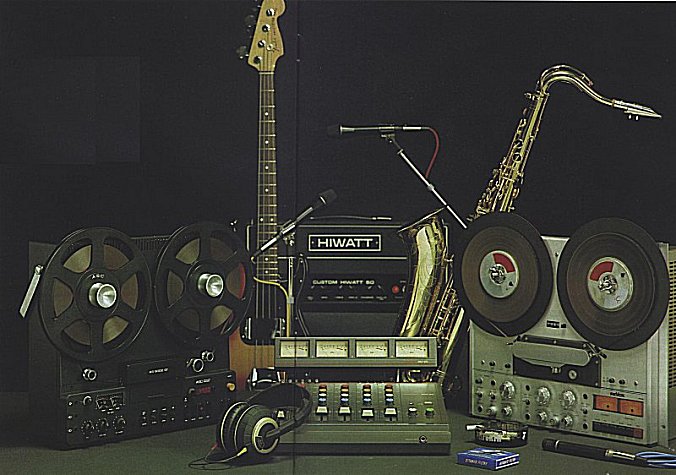
| Two new semi-professional tape recorders from Revox and ASC are competing for the favor of tape enthusiasts. |
|
|
|
|
“So anyone who weighs up the negative and positive details for both devices will probably opt for ASC.”
This was the conclusion of a test (AUDIO 8/1981) in which the new AS 3000 recorder from the Aschaffenburg-based manufacturer ASC was compared with the equally new B 710 device from the German/Swiss company Studer-Revox.
Barely six months later, it was time to compare two devices from these two manufacturers once again. This time, however, it wasn't about recorders, with which both companies had broken new ground, but about two full-grown tape recorders: the AS 6002 ST and the PR 99. To develop new and improved versions of the devices that had established both suppliers' international reputation. Of course, this excellent reputation comes at a price: with the hi-fi retailer charging around 3,500 marks for one of its luxury products, its competitors are also among the international elite in this respect. |
|
|
|
|
|
|
The test promised to be exciting; after all, both devices are descendants of well-known and proven tape recorders, which are well established in hi-fi circles under the names AS 6002 and B 77.
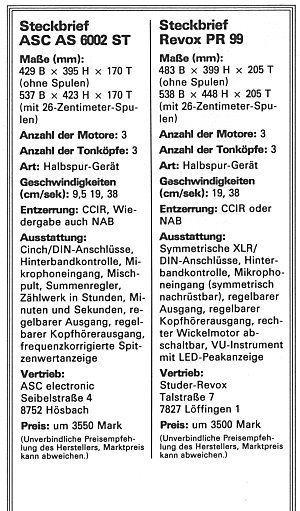
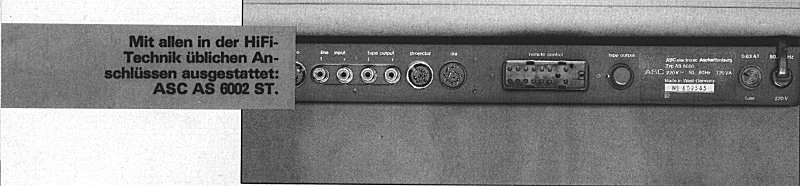
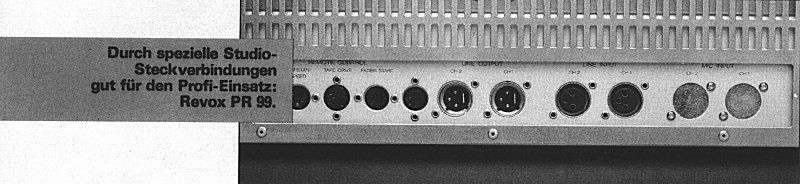
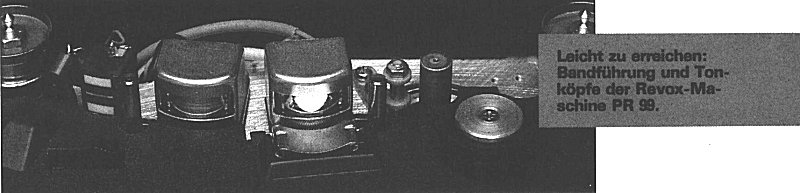
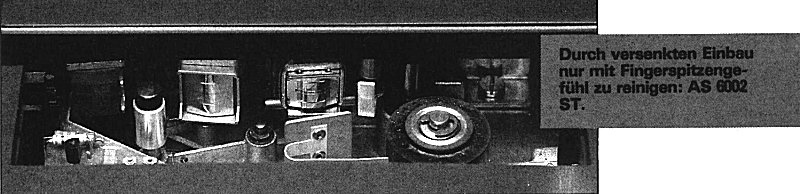
The comparison test should therefore not only show who is top of the class, but also what the additional expenditure of 800 marks (ASC) or 900 marks (Revox) for the more professional equipment really brings. Unlike their basic models, both machines are primarily intended for serious tape recording work. “The 6002 ST is designed especially for small studios, record studios, and broadcasting companies,” says ASC's head of development, Gerhard Zang, 31, summarizing the target user group. Broadcasters are particularly interested in using the PR 99 in mobile applications, i.e., in outside broadcast vehicles. But some recording studios have already ordered the new machine," says Revox press spokesman Jürgen Reith, 41, limiting the possible uses of the PR 99. But even dedicated hi-fi enthusiasts can benefit from the professional design of the two rivals, ASC and Revox. Not only do their suitability for high-quality microphone recordings and their robust construction set them apart from average devices, but also the CCIR studio equalization used in them (The PR 99 is also available as a NAB version, and the AS 6002 ST can be switched to DIN-S (CCIR) or NAB equalization during playback) also has advantages. So, for example, anyone who wants to send their tapes to record companies or radio stations for demonstration purposes will find the right partner in these two newcomers. Because if the technical and artistic quality even allows for preservation on disc, this is easily possible thanks to professional equalization. Otherwise, the AS 6002 ST differs from the basic version 6002 S in only one respect: the counter on the ST machine is calibrated in time, as is customary in studios. Of course, the ASC specialists charge a high price for this. In the age of digital watches, which can be purchased in department stores for as little as 30 marks, 800 marks for this extra feature and the modified recording equalization is a considerable amount of money. Zang comments laconically: “These custom-made products are only produced in small and therefore expensive quantities.” In all other respects, the ASC corresponds to its cheaper sister model, which has proven itself as an AUDIO reference device for many years (test in issue 3/1979). The PR 99 is different, with its completely changed name hinting at greater differences from the basic model: Symmetrical XLR connectors from studio technology, calibratable inputs and outputs, and a modified appearance indicate a significant redesign of the B 77 (tested in AUDIO 3/1979 and 5/1981). The aluminum front panel of the PR 99 is also more robust and less prone to dirt than the dark gray plastic front panel typical of Revox B 77 models. The clear layout and design of the controls remained the same, but the buttons and controls are now flush with the rest of the base plate. This makes the heads more accessible, which facilitates cleaning and demagnetizing the heads and tape guide elements, as well as cutting the tapes. The additional switch labeled “Tape Dump” (meaning “recycle bin mode”) also supports cutting tasks. This allows you to switch off the right-hand winding motor, and any unused tape can simply be thrown away in the trash without the rapidly rotating winding spool causing a nasty tape tangle. It remains completely incomprehensible, however, why the Revox people are depriving PR 99 owners of the excellent tape cutter built into the B 77. To improve the winding properties, which had always been neglected at Revox—with the exception of the A700, which is no longer manufactured—the developers added a second tape feel lever (located on the right) and increased the tape tension compared to the B 77. This means that, as with ASC devices, the tapes are always neatly rolled up even after a quick run. Even using studio tape on open-reel spools is a breeze with the adapters available as accessories. To achieve this, Revox made savings in other areas: the simple mechanical counter in the B 77, which uses a belt drive to register the revolutions of the right-hand tape reel, is also built into the PR 99. Revox also cut corners on the microphone connections, as the standard inputs are not very good. However, this is not particularly bad: anyone using a mixing console, which is likely to be the case with the PR 99, can do without these sockets anyway. However, if the microphones are to be connected directly to the device, the PR 99 can be easily upgraded. An additional circuit board costing around 75 marks, which any experienced tape recorder user can install themselves, makes this possible. The resulting symmetrical connection also allows the use of long cables without annoying humming or high-frequency interference. |
|
|
|
|
|
|
The listening test quickly revealed that the two newcomers, like their proven predecessors, offer outstanding sound quality.
At 38 cm/s in particular, there were hardly any noticeable differences between the recordings and the original reference discs.
A minimal tendency toward sharpness with the Revox and a tiny loss of height with the ASC machine were only noticeable during extensive listening tests.
There were also no differences in sound quality between the AS 6002 S, which was already slightly superior to the B 77 in the comparison test, and the two newcomers.
Only at high volume did the ASC 6002 S stand out due to a slightly higher background noise level.
Is the additional cost for one of the two professional models worth it? From a hi-fi perspective, the cheaper AS 6002 S remains clearly the ideal tape machine for home use. Instead of paying the extra 800 marks for the ST version, hi-fi enthusiasts would be better off browsing the extensive range of ASC accessories (such as remote control, timer unit, or four-track playback head). Playback of studio tapes is no problem for all ASC owners anyway, thanks to the switchable playback equalization. On the other hand, those who have turned their tape hobby into a second career are better served by the PR 99. The optimal arrangement of controls and features, which are otherwise only found on genuine studio equipment, quickly pay off in daily use of this machine. The XLR connectors also enable easy connection to professional equipment. However, this advantage is also a disadvantage, because the PR 99 has problems when connected to hi-fi systems: The low-impedance inputs are not compatible with all amplifiers, and the lack of RCA jacks means that owners will need to purchase special adapter cables. A thorough examination of the intended use and individual requirements in terms of features and ease of use should therefore always be carried out before rushing into purchasing one of these tape machines. One thing is certain: both the ASC reel-to-reel tape recorders and the two Revox tape recorders will continue to serve reliably for many years to come. |
|
|
|
|
|
|
This test report was taken from Audio magazine 01/1982 with the kind permission of Vereinigte Motor-Verlage GmbH & Co. KG.
Author: Wolgang Feld Photos: Wolfgang Schmid |
|
||
| ↑ back to top ↑ | ||
|
||
|