
|
Christoph's Tape Pages - Test report Revox A700 - |
|
Errand boy
|
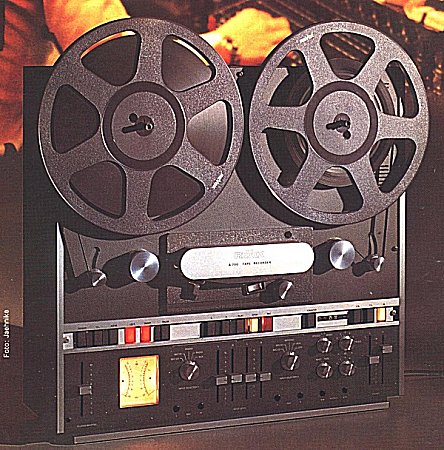
| If you enjoy good audio recordings and like to experiment, you need the Revox A700. |
|
 |
|
|
Old does not have to be outdated.
The Revox A700 tape machine, now in its fifth year of production, proves this with two very simple design features:
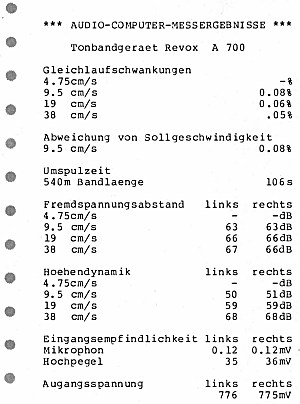
Even during the development stage, the engineers devised pioneering electronics that can fulfill every conceivable experimental requirement, offering something for everyone: Hi-fi enthusiasts who enjoy recording bands will appreciate the built-in mixing console, which allows them to mix four microphones. The language learner monitors his progress using the Duoplay method. Musicians with perfect pitch do not have to listen uncomfortably to concerts where the pitch on the record is too high. Thanks to the electronic control of the tone motor, which achieves excellent values for speed fluctuations through quartz stabilization, the speed of the A 700 can be changed in semitones using a control device—comparable to the fine adjustment on turntables. Simultaneous interpreters can perfect their skills, as the A 700 makes it very easy to carry out simultaneous interpreting exercises. An experimental tape fan will be impressed by the multi-playback technology and the possibilities of listening in while rewinding and using echo effects. A particular advantage is that it can continuously regulate the tape speed from 6.5 cm/s to 57 cm/s via a generator. The outstanding versatility that Studer engineers have given this machine is complemented by a number of useful techniques: A repeat button saves you from having to “play the piano” when searching for a specific spot on the tape. As long as the button is pressed, the tape is rewound; after it is released, the Revox continues to run in playback mode. The device's automatic operation is sophisticated. To use it, simply cover the beginning and end of the tape with clear film. If the “Auto” button is pressed in addition to the record or play button, the tape automatically rewinds at extremely high speed at the end—one kilometer of tape in just two minutes—and the A 700 starts recording or playing again from the beginning. This repeats itself without the errand boy getting out of breath—until the stop button is pressed or the power fails. This even allows for continuous background music with soft entertainment music, as is the case in luxury hotels, where it follows the pampered guest at every turn. For audiophiles, the outstanding recording quality that the machine can deliver at the fastest tape speed is the most important factor. The controllability increases by 9 decibels when transitioning from a speed of 19 cm/s to 38 cm/s. Revox achieved the dream value of 68 decibels of head dynamic range in the AUDIO computer test. This term indicates the difference between the maximum recordable level and the external voltage. Incidentally, since pop and jazz music contain a very high proportion of high frequencies, and since the upper frequency limit of tape recorders drops by several kilohertz at lower tape speeds, it makes sense to approach this level with high frequencies during the measurement test; Specifically: at 10 kilohertz, in contrast to amplifiers, which are measured at 1 kilohertz. This dynamic range of 68 decibels is so large that Revox owners need not worry about rapid overloading; they will easily be able to make excellent microphone recordings. The overload indicator also helps him with this. |
|
 |
|
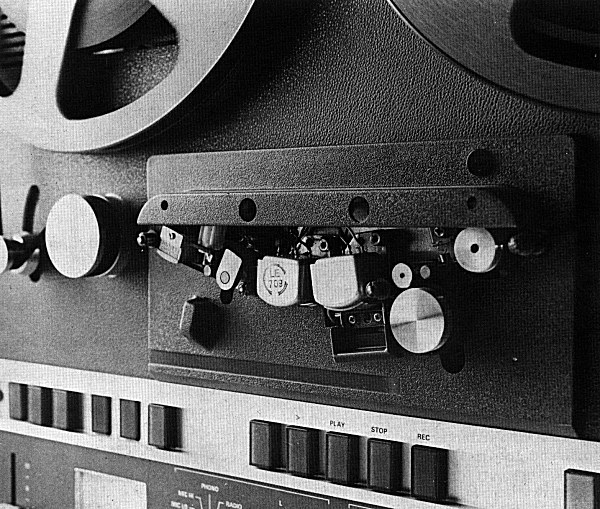
| Responsible for perfect music reproduction: the tone heads of the A 700 |
|
|
Since conventional analogue instruments are too slow for monitoring output levels, they cannot detect short-term peaks.
Studer engineers solved the problem in a simple way: they used virtually inertia-free light-emitting diodes that immediately flash bright red at the slightest overload.
The synchronization fluctuations also improve again when switching to the 38 speed. The AUDlO computer determined the excellent value of 0.05 percent, which guarantees that even the most sensitive ears will not be offended by the whine of a piano key strike. |
|
||
|
|
|
||
|
But there are other reasons to go for the 38 Sprint: the tape recordings last much longer than the 19 recordings because twice the tape surface is magnetized.
If you want to do even more, store your tapes in a pre-wound state, as this minimizes the copying effect.
The fast speed is also particularly well suited for tape montages, as the cutting point can be located much more easily.
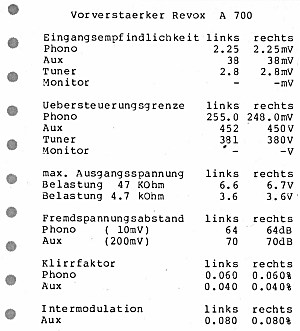
Finally, the Revox has another special feature: it includes a high-quality preamplifier, which has been certified by AUDIO computer tests as delivering excellent performance. During the listening test, it was noticeable that the low frequencies lacked substance. The advantage of this amplifier lies more in the reproduction of voices: the purity with which Esther Ofarim's voice (see AUDIO reference disc on page 96) is reproduced sounds live; even the quiet breathing recorded on the disc does not escape the preamplifier. Of course, it is debatable whether a hi-fi preamplifier belongs in a tape recorder. The additional electronics make the device considerably more expensive, and most hi-fi enthusiasts will probably already own a preamplifier when they purchase an A 700. The outstanding data and ease of use were the deciding factors in the A 700 was selected by the AUDIO editorial team to feed amplifiers or loudspeakers with the best music material or to play master tapes in the highest quality when testing tonearms and cartridges. You then have to scan the same music from records for which the tape served as a master—a precise and quick process for examining which musical details the tonearm-cartridge combination omits, distorts, or emphasizes. Anyone who buys the A 700 can be sure of two things: they will enjoy it for many years to come, and they will need to spend a few weeks getting to know it in order to discover all its possibilities. By the way: he can also enjoy music of the highest quality. |
||
|
||
| This test report was taken from Audio magazine 03/1978 with the kind permission of Vereinigte Motor-Verlage GmbH & Co. KG.
Author: Gerald O. Dick Pictures: Jaehnike |
||
|
||
| ↑ back to top ↑ | ||
|
||
|