
|
Christophs Tape pages - MX 55 - |
|
Class difference
|
|
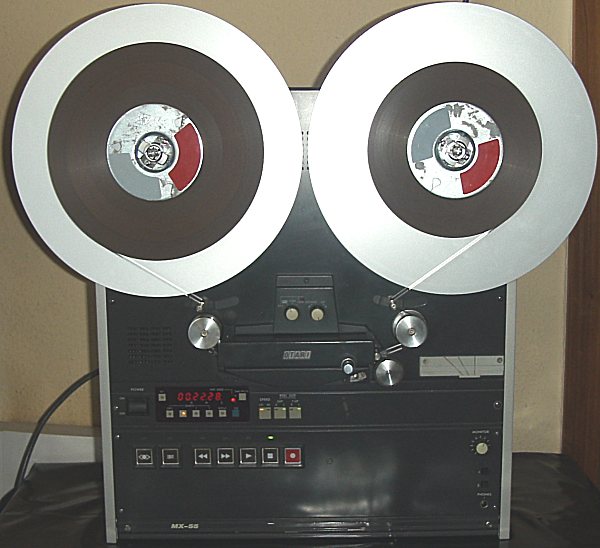
I find it difficult to write a few introductory lines here. Except maybe: I'm thrilled! Like every collector, I am always striving for something better. That's why it has long been my wish to own a professional tape recorder. Unfortunately, devices in this class are still usually quite expensive. Unfortunately, products from most manufacturers (e.g., Studer) are (still) beyond the budget I have set aside for these things. Now I have been offered a reasonably priced device (thanks, Michael) of Japanese origin, which has apparently been in service at a German broadcasting company for several years. Well, here it is, the Otari. As already indicated by “class difference,” this device no longer has much in common with my other “large-coil” models (which are certainly not bad either). The mechanics/electronics work with such precision that it can be a pleasure just to fast-forward and rewind. There are also a wealth of small details that are well thought out and make working with this machine much more pleasant (more on this, in detail, below). |
|
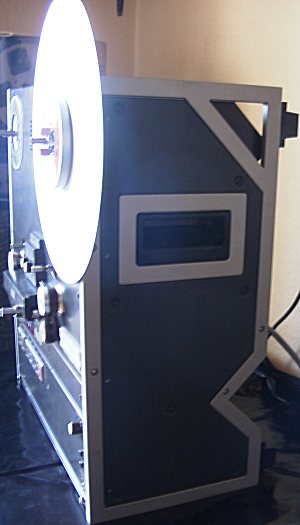 |
| Here is a side view showing the sturdy aluminum frame, which is necessary given the weight of approx. 35 kg.
The triangular recess is clearly visible. Here, the connection cables can be easily routed out, even when the device is lying flat. |
|
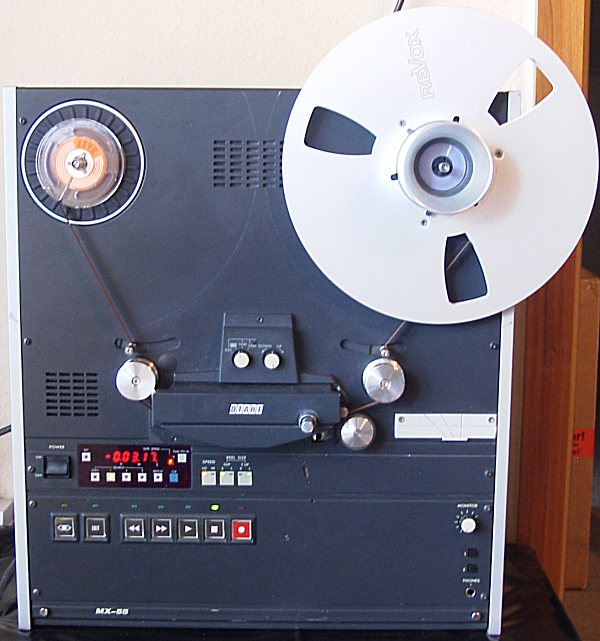 |
| Please do not attempt to replicate this with “normal” tape recorders! Here is a test to see how gently the device's tape tension control works. On the left is an 8 cm plastic reel, on the right a 26.5 cm NAB reel. This works (even with fast forwarding, rewinding, braking, etc.). The coil size, which can be adjusted separately for the right and left platters, is largely responsible for this. |
|
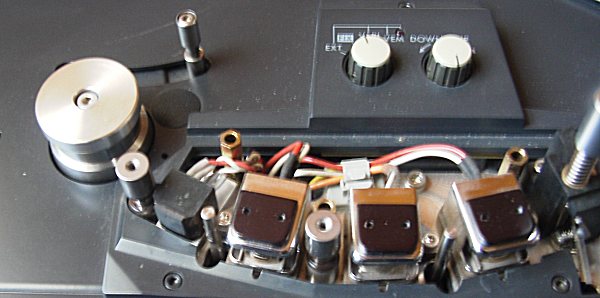 |
| The Sound Heads From left to right: Erasing head, recording head, playback head (4 tracks), playback head (2 tracks). Although this device is a 2-track model, an additional 4-track playback head has been installed. This means that 4-track tapes recorded on other tape recorders can also be played back. The built-in tape cutter can be seen on the far right. By pressing the (fortunately lockable) button, this cuts the tape directly behind the playback head and at the correct angle. |
|
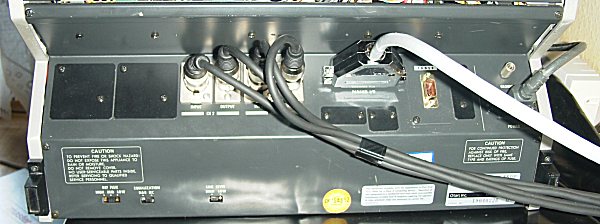 |
| The rear side The connection sockets and some important switches are located here. At the top are the 4 (symmetrical) XLR connectors for inputs and outputs. To the right of these is the 37-pin remote control connector. Three slide switches at the bottom for tape flow, equalization (IEC/NAB), line level. |
|
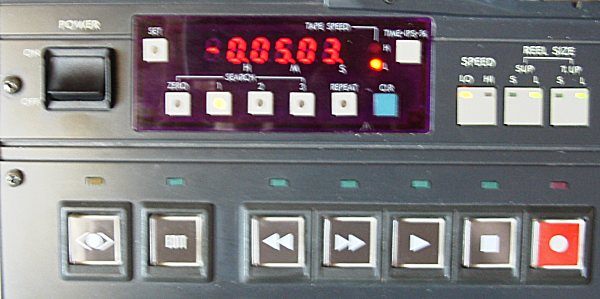 |
| The controls Most of the controls are the same as those found on conventional tape recorders, so here are just a few words about some special details: 6-digit display (with sign) that shows, among other things, the tape running time used, regardless of the selected tape speed, in hours, minutes, and seconds (very accurate). Furthermore, three different tape positions can be stored and then accessed at the touch of a button. A repeat function can also be activated between two selected points on the tape. The “Speed” button has a special function here. It switches between the “Lo” and “Hi” settings. These can be either the belt speeds 9.5 cm/s and 19 cm/s or the belt speeds 19 cm/s and 38 cm/s. The switch between these two speed pairs is made by a setting in the device. This means that although only two speeds can be selected (from the outside), the device still “controls” three different speeds. To the right of the speed switch are the aforementioned “reel size” switches (separate left and right). |
|
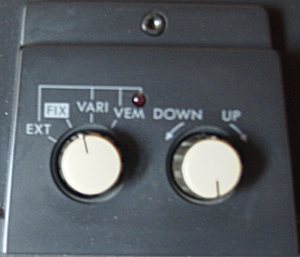 |
| A few more words about speeds: The speed of the belt transport can not only be switched, but also changed within a wide range (+/- 20%) (see image above). In addition, it is possible to connect an external clock generator (for synchronization with other devices, for example). The rewinding speeds are beyond reproach, regardless of the type and size of spools used. |
|
 |
| service friendliness Behind a small flap secured with two knurled screws, all elements required for adjusting and calibrating the device are accessible from the front. The green switch on the far left switches the built-in test oscillator (switchable between 100 Hz, 1 kHz, and 10 kHz) on and off. In the right third, there is another (slide) switch that switches between the 2-track and 4-track playback head. |
|
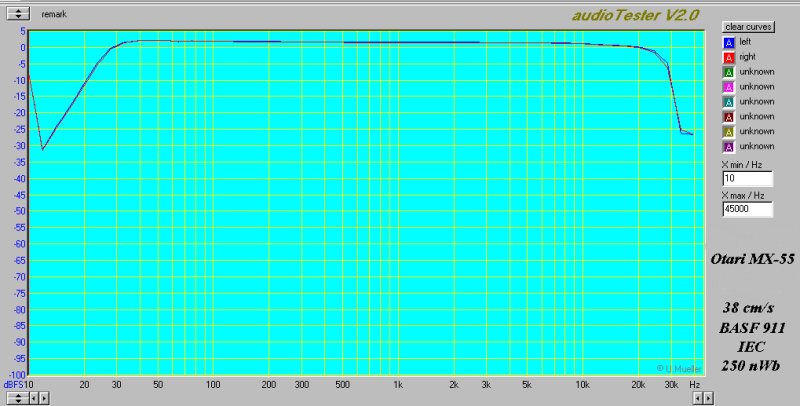 |
| (Almost) finally, a few words about sound: The subjective impression is simply fascinating. It is very difficult and requires turning the controls up to the maximum to still perceive the background noise of the tape. Interestingly, tapes recorded with other machines also sound (subjectively) better. Somehow more detailed and less noisy. For anyone who can “read” this kind of thing, the frequency response curve (created using the highly recommended “Audiotester” program (see my links)) is shown above (no, I didn't draw it with a ruler). The frequency response of this device, which is already several years old, still falls precisely within the manufacturer's specifications (30 Hz - 20 kHz +/- 2 dB) and is almost completely channel-symmetrical. I have never seen anything like this on any other tape recorder. |
|
| Since I don't yet have the exact technical specifications for the MX-55, the (almost) identical specifications for the successor model MX-5050 are shown below. |
|
| Fatal error: Uncaught mysqli_sql_exception: No such file or directory in /mnt/web514/c3/76/5591876/htdocs/tonband/en/db_connect.php:15 Stack trace: #0 /mnt/web514/c3/76/5591876/htdocs/tonband/en/db_connect.php(15): mysqli_connect() #1 /mnt/web514/c3/76/5591876/htdocs/tonband/en/daten1.php(5): include('...') #2 /mnt/web514/c3/76/5591876/htdocs/tonband/en/mein_mx55.php(203): include('...') #3 {main} thrown in /mnt/web514/c3/76/5591876/htdocs/tonband/en/db_connect.php on line 15 |