
|
Christoph's Tape Pages - Comparison Test Stellavox SP 8 / Uher Report Monitor 4200 from Audio 07/1982 - |
|
Ton-Träger
|
|
 |
|
|
Bird song recordings or concert recordings: Portable recorders enable hi-fi recordings without a power outlet. |
|
||
|
||
|
||
|
A ticket to one of the most exclusive hi-fi clubs costs exactly 11,356.50 marks:
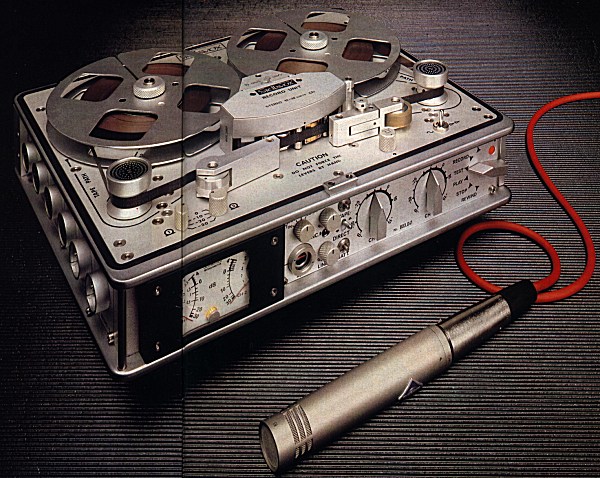
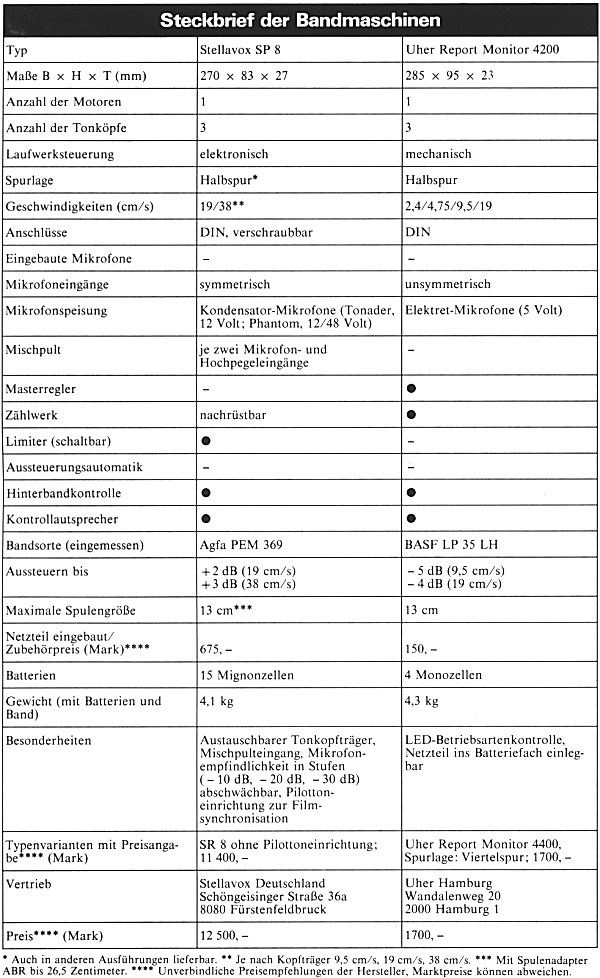
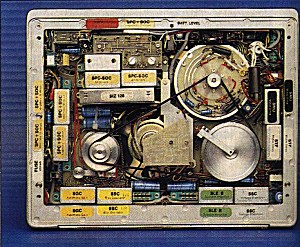
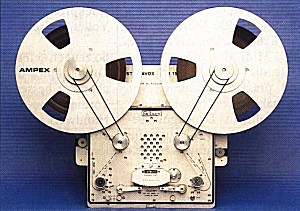
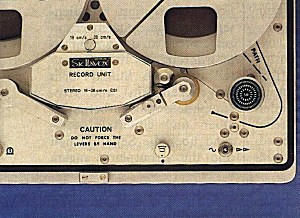
In return, you become the owner of a Stellavox SR 8, the ultimate in battery-powered tape machines. Of course, this only gets you a standing room ticket, because for this hefty sum, you get the standard version of this Swiss marvel—without a handle, counter, or power supply. Despite growing competition in the form of PCM recorders, Stellavox still has a future. For example, the SP 8 model enables film crews to produce synchronized image and sound recordings. A built-in pilot tone head, in conjunction with the camera, records synchronous pulses in addition to stereo sound recording, which control the projector during film playback. In addition, broadcasters will probably continue to work with existing analog tape machines in the longer term, meaning that original recordings made on site will still be needed in shoelace format. Other advantages of the Stellavox machine include its enormous stability, compact design, and relatively low power consumption. Stellavox manufactures two basic models for stereo recording. In addition to the tried-and-tested SP 8, the SR 8 has recently been introduced, which is identical except for the equipment for film-synchronous recordings and is intended purely for sound recording purposes. AUDIO had an SP 8—costing 12,500 marks—available for testing. Even the exterior of the mini machine revealed its solid design and precise manufacturing. With the exception of the frame, which is made of sturdy die-cast material, almost all parts are individually machined from solid blocks in a complex production process. Even the smallest knobs, whose handles are corded for better handling, testify to the solid craftsmanship at Stellavox. The design of this sophisticated mini machine is also exemplary: The main controls and peak meter are located on the front panel, while the left side panel houses the studio-standard input and output jacks. Since the top and bottom sections extend protectively over the sides and front panel, virtually no switches can be broken, even during rough mobile use. The arrow-shaped toggle switches for the two microphone inputs and the central rotary switch for the drive functions are particularly easy to grip. When this switch is set to the play position, the electronically controlled drive motor starts up with a gentle purr after a short pause. Two smooth-running, spring-loaded deflection rollers, in conjunction with two pressure arms, ensure uniform belt transport. In order to achieve stable tape running even after prolonged use, the pressure roller is not made of rubber (which is prone to wear and deformation), as is the case with most other devices, but of a special plastic that Stellavox sources specially from the United States. The quick-start device attached to the right-hand pressure arm is further evidence of the Swiss company's meticulous precision work: Pulling out the small button on the top causes the pressure roller to swing a fraction of a millimeter away from the capstan shaft, thereby interrupting tape transport and recording. Pressing the button triggers a flash start, enabling you to start recording with perfect timing. The inner workings of the Stellavox are also impressive: Despite their compact design, the plug-in modules of the amplifier and control circuits are clearly arranged. The mechanics inside also convey a sense of the proverbial Swiss watchmaking precision. |
||
|
||
|
|
|
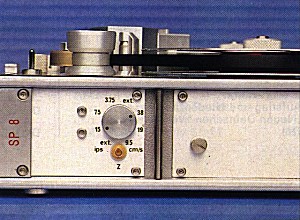
| Swiss precision down to the last detail: the Stellavox speed selector switch. Your electronics are neatly arranged in modules. Equalization switching takes place in the replaceable head cartridge, which also houses the equalization controls. | ||
|
||
|
|
|
| The ABR adapter for large spools (up to 30 cm in diameter) enables long recording times. | ||
|
||
|
The small Uher tape machine is not quite as high-tech and refined down to the last detail, but its main advantage is its amateur-friendly price.
The Uher Report is, of course, not a device that is individually handcrafted, but simply comes off the production line.
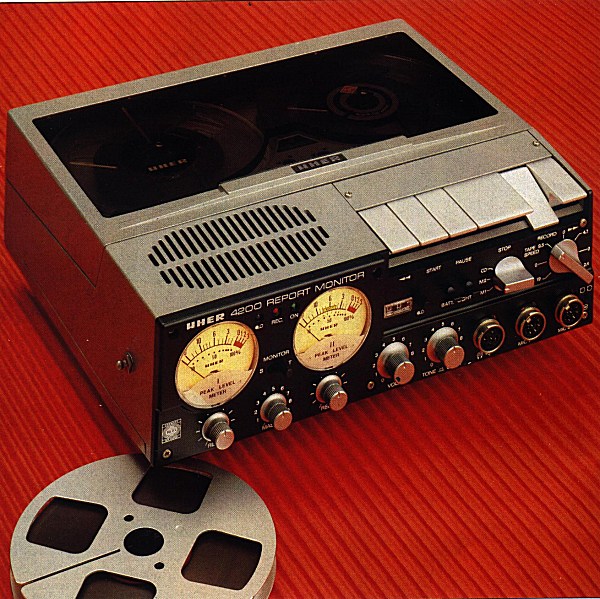
Over the course of its 20-year history, more than 800,000 copies of the report have been sold worldwide. But apart from their design and name, the latest models have little in common with their predecessors. Modern IC technology, improved tape guidance, large peak value displays, and a master control for recording and background tape monitoring make the proven tape machines of the Report-Monitor series (4200 = two-track, 4400 = four-track) still an attractive offer. The details also reveal the Munich-based company's model updates: The instrument lighting can be switched on either in energy-saving mode for 15 seconds (one press of the corresponding button) or for a longer period (two presses). Pressing the button again switches them off again after continuous operation. Four tape speeds—from 19 centimeters per second (cm/s) for high-quality music recordings to 2.4 cm/s for undemanding—but virtually endless—voice recordings—allow you to select the optimal speed for every purpose. The maximum uninterrupted recording time for the 13-centimeter reels of the Uher and the double-play-tape (price: around 15 marks) ranges from 24 minutes (19 cm/s) to over four hours (2.4 cm/s). |
||
|
||
|
||
|
||
|
Similar to the examination of the equipment and operation, the listening test of the two dissimilar models also began with the exciting Stellavox.
The Swiss machine impressed the test editors not only visually.
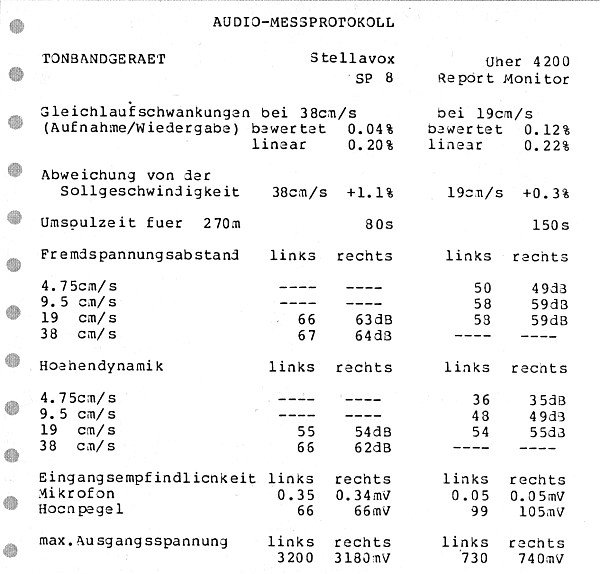
The measurements (signal to noise ratio of more than 60 decibels) had already clearly demonstrated the class of this sophisticated mobile device, and it did not disappoint in the listening test either.
Even at a running speed of 19 cm/s, the Sheffield Drum Record was reproduced with exceptional precision and clarity. Only during quiet passages was there a very faint noise, which did not interfere with normal music programs, however. Compared to the AUDIO reference machine ASC AS 6002, which exhibited a slight drop in treble, a slight loss in the low-frequency range was noticeable on some reference discs with the Stellavox. However, after switching to 38 cm/s, this slight weakness was no longer noticeable: Only after intensive listening comparisons was the test jury able to distinguish the pre-band program from the rear band signal. A touch more openness was—similar to the ASC—the only sound characteristic for the monitor switch position on pre-tape. As expected, the Uher Report 4200, operating at 19 cm/s, performed well. A slight hiss and somewhat muffled highs accounted for the difference between the front and rear tracks here. At 9.5 cm/s, music passages already noticeably affected the fairly good sound quality, and the slower speeds are only suitable for background music or voice recordings anyway. For fans of rotating reels and audiophiles who are looking for excellent sound quality, the Uher Report Monitor 4200 is really the only choice. Because with this, you can show yourself off to hi-fi enthusiasts without hesitation. Especially since entry into Stellavox high society will probably remain denied to ordinary mortals in the future as well. |
||
|
||
|
This test report was taken from Audio magazine 07/1982 with the kind permission of Vereinigte Motor-Verlage GmbH & Co. KG.
Author: Hans Günther Beer Photos: Wolfgang Schmid |
||
|
||
| ↑ back to top ↑ | ||
|
||
|