
|
Christoph's Tape Pages - Comparison Test Akai GX 747 / Tandberg TD 20A SE / Teac X-1000R from Audio 08/1982 - |
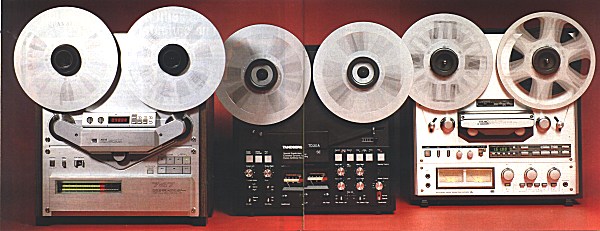
| Tape recorder manufacturers are not giving up. They are responding to the challenge posed by top-of-the-range cassette recorders with increasingly sophisticated models. |
|
 |
|
|
By the mid-1970s, the time had come.
The triumph of the cassette recorder seemed to have finally put an end to the tape machine, which had been dominant until then.
The sales figures for the much more user-friendly and long-established high-quality recorder spoke for themselves, and the tape recorder market shrank and shrank.
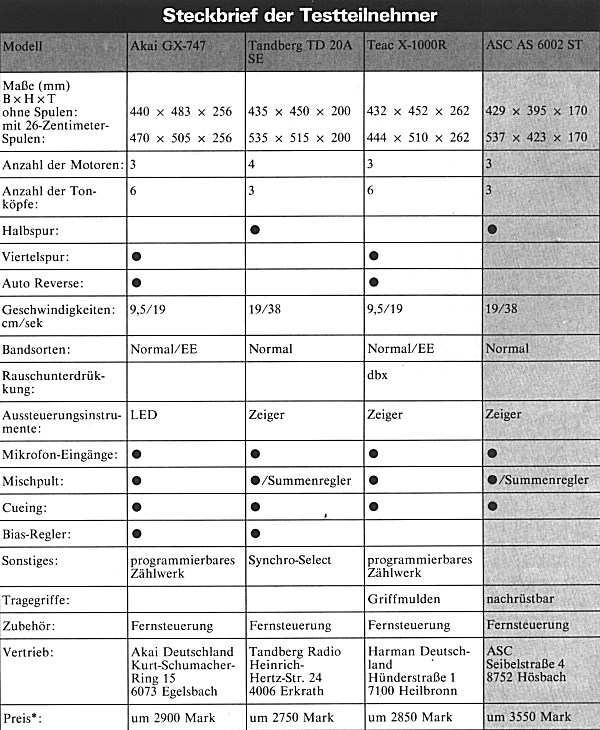
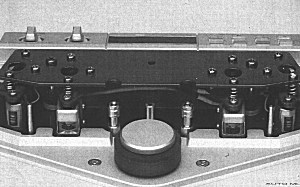
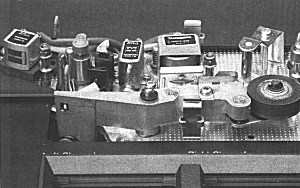
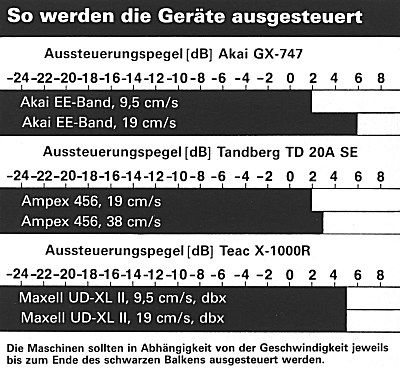
But despite all the doom and gloom, the good old tape machine is not dead yet. On the contrary: it has now reestablished itself. However, tape machine buyers in the 1980s usually expected more from their machines than just the ability to make recordings. Above all, these specialists are characterized by their desire for first-class sound quality and special applications, such as their own microphone recordings. For their part, tape recorder manufacturers are doing everything they can to meet these requirements. AUDIO tested three tape machines designed for semi-professional use: • Akai GX 747 (2900 Mark) • Tandberg TD 20A SE (2750 Mark) • Teac X-1000R (2850 Mark) which competed against the ASC AS 6002 ST AUDIO reference tape recorder. The Akai machine, which has been available for about a year, and the brand new Teac X-1000R are very similar in their basic design. Both devices were designed to work with the new EE tapes coated with chrome or chrome substitutes. With these bands, the developers aim to increase the dynamic range and dynamic response by several decibels. In practice, these enhancements mean clearer, undistorted highs and, above all, less annoying tape noise. But that wasn't enough for the Teac developers. They also incorporated dbx noise reduction circuits into their top-of-the-line tape machine, which, according to the brochure, are supposed to guarantee an additional 35 decibels of dynamic range expansion. For example, the X-1000R is specified to have a total noise voltage ratio of 100 decibels when using dbx. The Norwegian Tandberg developers, on the other hand, chose a different path. They incorporated special equalization into the TD 20A SE to achieve high dynamic values. ""In recent years, magnetic tape technology has made tremendous progress,“ explains Dieter Ludenia, managing director of the German Tandberg headquarters in Düsseldorf. ”Above all, the peak level capability of modern tapes has increased to such an extent that we have been able to confidently dispense with some of it." In plain language, this waiver means the following: With every tape recorder, the high-frequency signals are lowered by a certain amount during recording and raised again by the same amount during playback. The special equalization of the Tandberg machine, on the other hand, reduces the amount of lowering and raising. On the one hand, this comes at the expense of the treble dynamics, but on the other hand, the lower treble boost during playback also means that less noise is amplified. The result: higher dynamics. The rest of the Tandberg machine's design also clearly reflects the trend toward semi-professional devices. It is the only machine in the test field that, in addition to a tape speed of 19 centimeters per second (cm/s), also offers a fast speed of 38 cm/s, while the Akai and Teac models are limited to 19 cm/s and the next slowest speed of 9.5 centimeters per second. The Tandberg also only has two tape tracks, whereas the two Japanese models each have four tracks, which are naturally narrower. Compared to the four-track system, the two-track method generally offers greater dynamics, but at the expense of playing time, which is only half as long per tape. Operating at maximum tape speed, the Akai and Teac therefore achieve four times the playing time of the Tandberg. In addition, there is a feature that fans of tape machines who are particularly conscious of convenience will appreciate: both Japanese manufacturers offer the option of auto-reverse operation. The tape therefore runs in the opposite direction on demand without having to be turned over, both during recording and playback. For this reason, both machines are equipped with a total of six tape heads (Tandberg: three). |
|
||
|
|
|
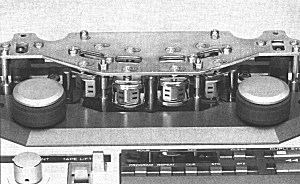
| As a reverse machine, the Akai has two sets of sound heads ... | ... Tandberg, on the other hand, only requires one ... | |
|
||
|
||
| ...and the Teac again two sets plus double capstan. | ||
|
||
| As is mandatory in this class, the belt transport is carried out by three separate, electronically controlled motors on all three machines. In the Tandberg, a fourth motor transports the pressure carriage to the sound heads during recording and playback. The other features were extremely extensive in all three test candidates. In addition to a programmable counter, which Akai also has, another noteworthy feature of the Teac is the ability to remotely control both machines from the tape deck when transferring to a Teac recorder: “Of course, other recorders can also be modified accordingly with little effort,” says Weert Meyer, product manager for Teac at Harman Germany in Heilbronn. | ||
|
||
|
|
|
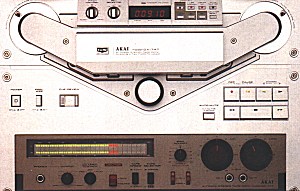
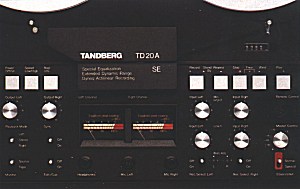
| Clear layout of controls: Akai GX-747. Rarely used switches are located behind the front flap, which, when closed, leaves only the instruments exposed. | Large, convenient buttons for drive control: Tandberg TD 20A SE. At the bottom right is the toggle switch for special equalization. | |
|
||
|
||
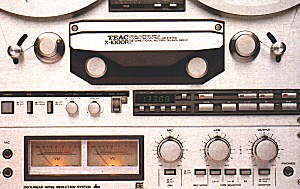
| The buttons are a little too small and too close together: Teac X-1000R. When recording, the level meters can always swing to the end of the scale. | ||
|
||
|
But regardless of features and convenience, what ultimately counts with a tape machine is its sound quality.
In the first part of the AUDIO test, the three test candidates had to demonstrate their measurement capabilities.
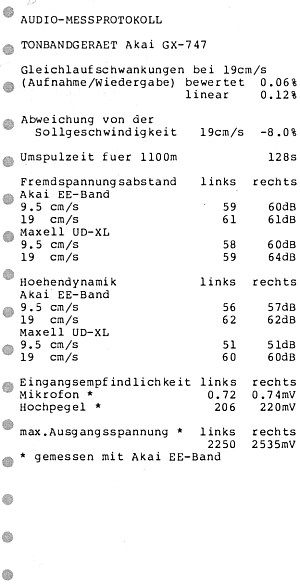
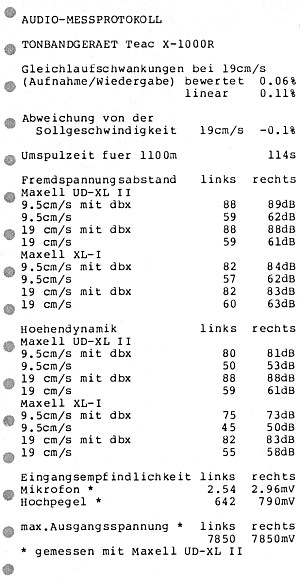
As expected, the Teac offered by far the best dynamic values when the dbx circuit was switched on.
It achieved a maximum signal-to-noise ratio of 88 decibels.
The Akai, on the other hand, only reached 64 decibels, which is still a good value without a noise reduction system.
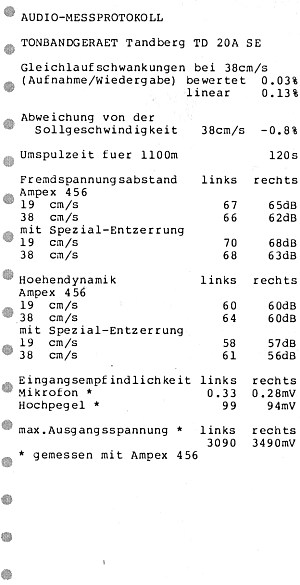
At a tape speed of 19 cm/s, the Tandberg achieved 70 decibels with the aid of special equalization; at 38 cm/s, it was two decibels less.
When switching from normal to special equalization, the dynamic range decreased from an excellent 64 decibels to a still outstanding 61 decibels, while the dynamic range increased by about three decibels.
The listening test of the tape machines turned out to be extremely extensive due to the different speeds, tape types, and equalization settings. The AUDIO reference machine ASC AS 6002ST served as a benchmark. Numerous reference discs and PCM tapes, played on the Technics PCM machine SV-P100, were available as program material. The dynamic PCM recordings on the AUDIO test disc proved particularly challenging for the test candidates. Im Vergleich zwischen den beiden Vierspurgeräten Akai GX747 und Teac X-1000R (ohne dbx) zeigte sich eine leichte Überlegenheit der Teac. Even without dbx, it produced less noise than the Akai machine, which obscured the music despite its EE tape material and 19 cm speed. As a result, impulses did not come across as dry and contoured enough, and the drumbeats in the AUDIO listening test inventory appeared too muffled and soft. Die Teac dagegen klang mit EE-Band und bei hoher Bandgeschwindigkeit insgesamt offener und freier. The Teac, on the other hand, sounded more open and free overall with EE tape and at high tape speeds. Even the dreaded noise tails, which occur as a lingering veil after pulses, especially with very effective noise suppression systems, were unknown to the machine. This is likely due primarily to the Teac's fundamentally good signal-to-noise ratio. Since the EE tape was marketed with the argument that it offers almost the same quality at low tape speeds as high speed and normal speed tapes, a corresponding comparison was carried out. This, of course, went in favor of the normal band. The highs sounded more open and free on the Teac and, incidentally, also on the Akai at 19 centimeters per second and normal tape. In a direct comparison with the original PCM tape, played back on the Technics SV-P100 digital recorder, the Teac with dbx exhibited a slight harshness in the impulses. This made some instruments sound too cold—for example, the piano and timpani. The Tandberg, on the other hand, appeared slightly softer at high tape speeds and with special equalization. Overall, the Norwegian machine sounded more precise, transparent, and open than the Teac with dbx and EE band. There was only very slight noise, an area in which the Tandberg was even superior to the ASC reference. With normal equalization, however, the differences were reduced to an absolute minimum. At a tape speed of 9.5 centimeters per second, the ASC ultimately had a slight advantage, sounding a little clearer and more transparent despite the increased noise level. This was particularly noticeable with string instruments (AUDIO reference record “La Boutique Fantasque”). Ultimately, however, the Tandberg TD 20A SE impressed the test panel with its excellent sound quality, especially at a tape speed of 38 centimeters per second and with special equalization. This makes them particularly interesting for tape fans who want to make their own live recordings. The high signal to noise ratio ensures interference-free recordings. Despite dbx and the use of EE band, the Teac X-1000R does not quite match the quality of the Tandberg. It is still suitable for microphone recordings, provided that high tape speed and dbx are used. Using EE tape, which is half as expensive as normal tape, is not cost-effective. Even with the Akai GX 747, if you are willing to lower your expectations just a little, you can confidently do without EE band. At a tape speed of 9.5 centimeters and EE tape, the sound quality is still noticeably lower than at double speed and normal tape. The machine will probably only join the top class once it is available as a fast half-track device with a built-in noise reduction circuit. But even such progress has something to counteract it from the Teac men. The X-1000R is also scheduled to be launched at the end of 1982 as a high-speed version with 38 centimeters per second, half-track, and dbx. It remains to be seen how the test winner Tandberg will extricate itself from this predicament. |
||
|
||
|
||
|
||
|
|
|
|
||
|
||
|
||
|
This test report was taken from Audio magazine 08/1982 with the kind permission of Vereinigte Motor-Verlage GmbH & Co. KG. Author: Hans Günther Beer Photos: Wolfgang Schmid |
||
|
||
| ↑ back to top ↑ | ||
|
||
|